Part III · OHIO, IOWA, OREGON · Chapter 12
Lest His Father Find Him
Iowa · 1935
In the record Charles Franklyn Krewson (1873–1935) · Galen Vane Krewson (1897–1957) · Charlotte "Lottie" Melissa Hall (1877–1917) · Gladys Ethelyn Thomas (1902–1968) · Bernadette Matilda Michiels (1910–1975) · Herald Krewson (1911–1913) · Glen U. Krewson (1903–1913) · Marvel Krewson · Earl W. Krewson · Bill Krewson · Michiela Small Kuehn (1910–1975)
Some time in 1935, in the coal-and-corn country of southern Iowa, a man of thirty-eight named Galen Vane Krewson left his father's house and did not come back. He went as far as the country allowed — to California — and he stayed gone. His father, Charles Franklyn Krewson, died the same year, and nobody knew where the son was to tell him.
Thirty-four years later, in the autumn of 1969, Galen's own eldest son Al, out of the Army and living in Ottawa, Illinois, wrote a letter into the family he had never met, and it found its way to Bill Krewson of Hammond, Indiana, his father's first cousin. Bill wanted to meet him "to see if I were for real." When he did, "he thought at first I was 'Gale' (my dad) cuz I looked so much like him" [1]. And Bill told him why his father had run:
Bill had been wondering about this, because my dad had disappeared from the face of the earth as far as the family knew … the last time he was heard from was in 1935. I do know for a fact that my grandfather Charles was after my dad's blood, because he blamed my dad for the deaths of a couple of other sons. Bill told me this was all circumstantial and never proven, and he did not believe my dad killed them. He thought perhaps Charles found him and blew him away. This was the reason for my dad disappearing so suddenly. He literally feared for his life and got as far away as possible from Iowa.
Al Krewson to Michael Krewson, email, 21 January 2005 — family archive, al-krewson-early-childhood-1-2005-01-21.htm [1].Bill put Al in touch with a second cousin, Earl, in Portland, Oregon, and Earl said the same, in the words Al kept:
Earl said he was on the run lest his father find him and blow his brains out. My dad would have no way of knowing his dad died in 1935, as no one could find him to inform him of the death. So, my dad was on the run when no one was chasing him anymore.
Al Krewson to Michael Krewson, 21 January 2005 — al-krewson-early-childhood-2-2005-01-21.htm [1].That is the rift this book has been walking toward since a tree-thief was barred from communion and two brothers spent twenty-nine years over a burned will. It is not documented — there is no court record, no newspaper, no death certificate for the two other sons; there is Bill's word to Al and Earl's word to Al and Al's word to Michael, three tellings deep, and Bill's own caution that it "was all circumstantial and never proven." The book records it as the family told it, and marks it as such. But it is where Part III ends: with a father who wanted his son dead, a son who ran, and a death that ended the pursuit without anyone telling the pursued.
Charles, the twin
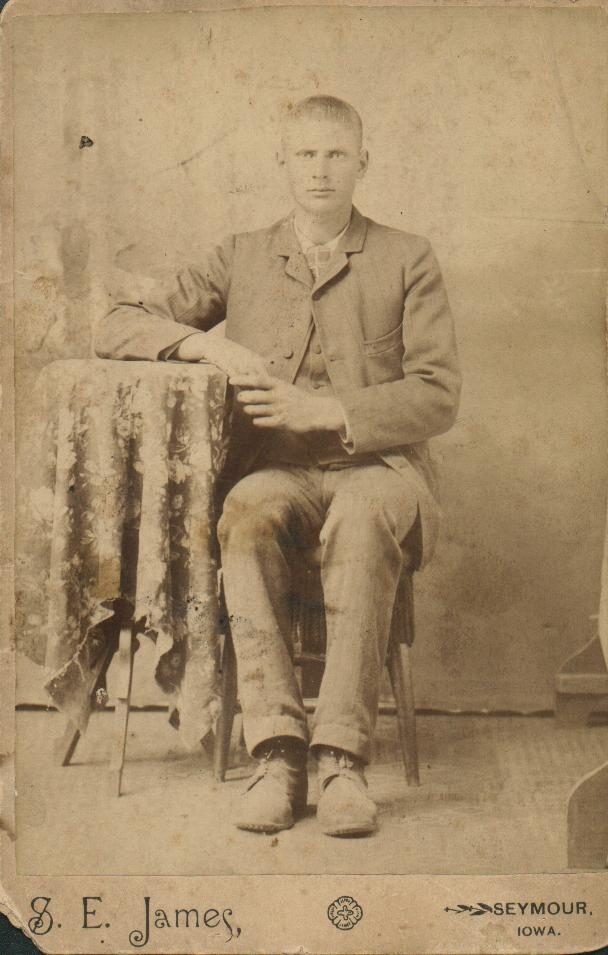
Charles Franklyn Krewson — "Franklyn Charles," in his grandson's memory — was born in 1873, and if the back of the family photograph is right, he was born with a twin sister, Mary [2]. He is the young man in the bowler hat and wire-rimmed glasses standing behind his parents in that print, at about seventeen; three years later, in 1893, he sat alone for S. E. James, photographer, of Seymour, Iowa, for the cabinet card that is the only certain picture of him young [2]. A third portrait, taken in 1930, shows him at fifty-seven, five years before he died: a heavy-faced old farmer in a suit [2]. Between the two portraits is the whole of his documented life, and it is almost nothing: a wife or two, a set of children, a farm somewhere in the three counties around Centerville, and the year 1935.
The wives are the first problem, and it is one the family's record has not solved. Annette's Ancestry chart pairs Charles with an "L. Michele Marshall," 1888–1956, whom the family called Lottie, and Michael's own photograph file labels a pair of studio portraits "Charles and Lottie Krewson, wedding pic, our grandparents" [3]. But Lottie was born in 1888 and Galen in 1897, when she would have been nine; and Marvel, Galen's oldest sister, was born before him. The same chart seats another woman beside Charles: "C. Hall Krewson," 1877–1917, with parents named Hall, a Krewson by marriage, whose place in the family the record leaves open [4]. The arithmetic allows only one reading. Charles married first, about 1895, a woman born in 1877 — presumably the C. Hall of the chart — who bore him Marvel, Della, Anna Marietta, Galen and the two sons who died, and who died herself in 1917; and then, in his forties, he married Lottie Marshall, fifteen years his junior, whose wedding portrait the family kept and whose name it remembered because she was the grandmother the grandchildren could have known. Galen's mother, on this reading, is the woman the record calls C. Hall, and nothing in the family's hands gives her first name. A marriage record from Appanoose or Wayne County would settle it in a minute.
It matters beyond the chart, because of the family's oldest legend.
Michael's father was, in Al's phrase, "absolutely stuck" on the story that the family had a Cherokee ancestor from Oklahoma. Al himself believed there was Native ancestry in the line but doubted the Cherokee part — from old photographs he remembered, his own guess was Blackfoot or Crow — and described a possible ancestor as a chief's daughter, of whom he had heard two separate and possibly conflicting stories naming the same woman, "and didn't have enough to sort out which — or whether — either was accurate." Michael, in 2026, unsure where he had heard it, attached the story to the C. Hall Krewson of the chart: she "was supposedly Cherokee."
The family record's story "An Unresolved Family Legend," from Al's emails of 2005, and its card for C. Hall Krewson (2026-08-05). Family lore, kept as Al framed it: unresolved [5].The book can add one thing to that, and it is not a document but a test. Michael's autosomal DNA, run twice by FamilyTreeDNA against two generations of reference panels, comes back European to the limit of the method: 99 per cent on the older panel, 100 per cent on the newer, with the ancient-origins breakdown reporting "non-European, 0%" [6]. If Galen's mother had been Cherokee, or Blackfoot, or Crow, Michael would carry about a sixteenth of her — roughly six per cent — and a sixteenth is well inside what these tests detect. They detect nothing. So the legend, if it is true at all, is not about Galen's mother, and not about anyone within four or five generations of Michael in the direct line; it is either about a collateral relative — a great-aunt's husband, a cousin's wife — or it is a story, of the kind a great many white American families told themselves in the twentieth century, and the record cannot tell which. What it can say is that the woman who has carried the story on the family's chart, whoever she was, was almost certainly not Native. Al, who framed it as unresolved, would probably have accepted that; the book leaves the story where he left it, and adds the number.
Galen
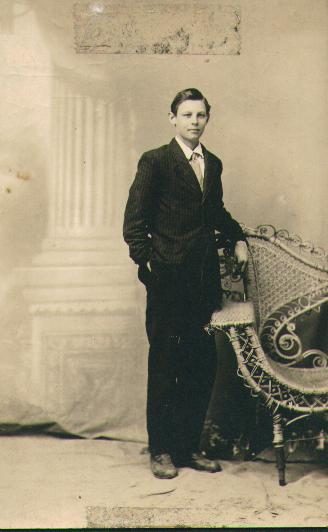
Galen Vane Krewson was born in Iowa in 1897 and photographed there at fourteen in 1911, standing full-length in a studio in a suit that was not quite his size [7]. He was a machinist — "Machinist, Fluorescent Lamp Co.," his son's 1943 birth certificate would say — and, by the account of the cousins who knew him, "definitely a lady's man out to get whatever and whomever he could," with "multiple marriages … a couple of wives up to 1935 when he disappeared" [1]. The family keeps a photograph labelled "Galen V. Krewson with 1st wife, around 1919 or 1920" — a young couple, he about twenty-two, she unnamed [7]. And Annette's chart gives him another: Michiela Small Kuehn, 1910–1975, and a daughter by her, Maurietta, born in 1931 [8].
That daughter is how the family knows any of this is true. Annette Maichen — Maurietta's granddaughter — is Michael's closest DNA match in the world: 466 centimorgans shared, a figure that sits squarely in the range for a first cousin once removed or a half-great-aunt's grandchild, and cannot be explained by any relationship more distant [6]. In August 2026 she sent him a screenshot of her tree, and on it was "Gaylen V. Krewson Sr., 1897–1957," with Michiela as his wife and Maurietta as their daughter. The family that had spent three centuries proving itself with marks on deeds and entries in church books now had a number: 466. It does not prove that the Michiela of the chart was the woman in the 1919 photograph — her own birth year, 1910, would make her nine in it — and the record refuses to force the match. What it proves is that Galen had a daughter in 1931, before he left Iowa, whom his later children never knew, and that her descendants and his are the same blood to within a few segments. Galen's four children and Maurietta's grandchildren met, in effect, in a laboratory in 2026.
By 1932 Galen was in California — "resided in California 11 years," the 1943 certificate says [7]. If the cousins' 1935 is right for the flight, then either the certificate's eleven years is a round number or Galen had been going back and forth; the two dates cannot both be exact, and the book records both. What is certain is that by the early 1940s he was in Los Angeles, working steadily as a mechanic, and that he had met an English girl.
What the fuller record confirms
Michael's own Ancestry.com tree — a hundred and fifteen people, with the record collections each fact leans on, and a gallery of photographs behind it [13] — answers most of the questions the reasoning above had to work around. The book keeps that reasoning in place rather than replacing it, so the reader can see that the tree's answers agree with it.
The wives are not a problem. Charles married once, so far as the tree knows: Charlotte Melissa Hall, called Lottie, on Christmas Day 1895 in Appanoose County — born 2 October 1877 at Cincinnati, Iowa, dead at Centerville on 28 April 1917, buried at Cincinnati, with a Find a Grave entry and the 1905 Iowa census behind her [13]. "C. Hall Krewson, 1877–1917" and "Lottie" were the same woman; the "L. Michele Marshall, 1888–1956" of the screenshot was a misreading, and 1888 is the birth year of a different Marshall three cards over. So the arithmetic was right and the woman it found has a name, and the wedding portraits the family kept are of Galen's mother after all. The relative's tree of the Knight line, sent the same day, spells Galen in the Spanish manner as "Galen Vane Krewson Hall" — the mother's surname after the father's — which is a third witness to the same fact [13].
And the year 1935, which this chapter had only from Al's memory of what the cousins told him, has a newspaper. The Belleville News-Democrat of 12 June 1935 settles it: "Charles Krewson, 61-year-old resident of the St. Clair Co. Home, died of complications at 6:30 o'clock yesterday evening in the County Hospital … He married Miss Lottie Hall many years ago. She is dead. He leaves four children: Mrs. J. W. Douglas of 950 East Main street, Belleville; Mrs. Robert I. Sloan of Mankato, Kan.; Mrs. Edward Mardecai of Dewar, Okla., and Gaylen Krewson, residence unknown, and two brothers, George and Vess Krewson of Missouri. The body … will be sent to Cincinnati, Iowa, for burial" [15]. The heavy-faced old farmer of the 1930 portrait died in the county poorhouse at Belleville, Illinois, near his youngest daughter, and the newspaper printed what the family would say for seventy years: that nobody knew where his son was.
"The deaths of a couple of other sons" were real, and they were in one year. Herald Krewson, born 18 September 1911, died at Cincinnati, Iowa, on 24 March 1913, at eighteen months; Glen U. Krewson, born 30 November 1903, died there on 26 June 1913, at nine [13]. Galen was fifteen. What a fifteen-year-old could have had to do with either death the record does not know, and Charles's blame, if Bill Krewson reported it rightly, was the blame of a man who had buried two boys in three months. Marvel was the eldest, born 1899 and buried in 1974 at Henryetta, Oklahoma — the country of the farm near Tulsa; Della was born in 1908 at Guymon, in the Oklahoma panhandle, so the family had been in Oklahoma and come back; Anna, the youngest, was born in December 1914, two and a half years before their mother died [13].
And the "first wife, around 1919 or 1920" has a name too, and the photograph has a caption in a newspaper. The Muscatine Journal of 14 January 1920, page 10:
QUIET WEDDING SOLEMNIZED AT UNITED BRETHREN PARSONAGE. A quiet wedding ceremony was solemnized at the parsonage of the United Brethren church, 507 East Sixth street yesterday afternoon, shortly after 2 o'clock when Miss Gladys E. Thomas became the bride of Gaylen V. Kreyson. Both young people make their home in Muscatine … Mr. Krewson has just returned home from overseas where he saw considerable active service and received a number of severe wounds. The bride was raised on a farm near Letts. Mr. and Mrs. Krewson expect to make their home near Letts, going to housekeeping this spring.
Muscatine Journal, 14 January 1920, p. 10 [14].Galen Vane Krewson had been to France — or a Muscatine reporter was told he had. He was twenty when the draft card was filed from a Louisiana address in 1917–18 and twenty-two when the paper called him a wounded veteran, and in sixty years of family letters about him nobody said so — not the cousins, not his sons, not the grandmother who despised him. And his death certificate (chapter 13) answers the question "Was deceased ever in U.S. Armed Forces?" with "No" — though the informant was a prison file that did not know his parents' names either. A draft registration is not service; a wedding notice is what the bridegroom said; a prison's file is what it had. The book carries the wound as the newspaper's claim, chapter 16 lists it with that caveat, and an Army file or a pension index would settle it. Gladys Thomas, seventeen, of a farm near Letts, is the girl in the photograph. The marriage did not hold. The tree gives him five: Gladys in 1920; Cora M. Eaves, in Cleburne County, Arkansas, on 15 June 1927; Bernadette Matilda Michiels, in Tulsa, on 8 April 1929 — Annette's "Michiela," her surname garbled into a first name, born in Chicago in 1910, the mother of Maurietta; Margery, at Yuma, in 1942; and an unnamed woman in Houston on 29 November 1950 [13].
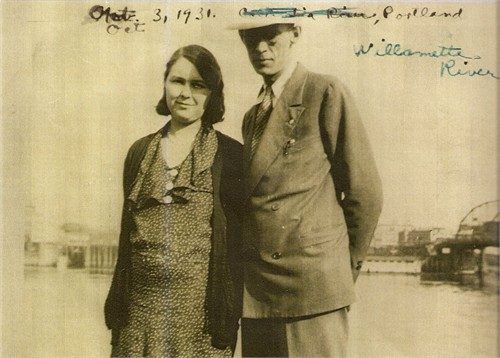
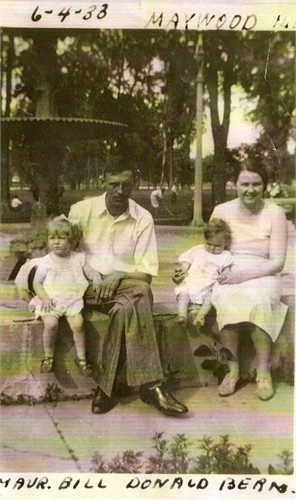
Two photographs from the Bernadette years say what "on the run" meant. One is captioned in ink, "Oct. 3, 1931 — Willamette River, Portland": Galen in a pale hat and a double-breasted suit, Bernadette in a print dress beside him, the bridges behind. The other, "6-4-33 MAYWOOD ILL.", is the four of them on a park wall in a Chicago suburb — a two-year-old girl, a man, a baby, a young woman — and along the bottom edge, in pencil, the names: MAUR. BILL DONALD BERN. [13]. Michael's own file name for the first one supplies the key: "Galen Vane Krewson aka Bill Small." He was Bill Small. That is why Maurietta's surnames on the tree begin with Kuehn and end with Small, why Annette's chart calls her mother "Michiela Small," and why a baby named Donald Charles Kuehne, born at Portland in May 1932, whom the tree had attached to a ten-year-old Margery by mistake, is his son: the family in the Maywood photograph is Bill and Bern Small and their two children. A man who does not want his father to find him does not keep his father's name, and Earl's sentence — "on the run lest his father find him" — has a document under it now. Bernadette died in Burbank in 1975; Donald in Cook County, Illinois, in 1980; Maurietta in Corvallis in 2008, and her granddaughter's DNA is where this chapter began.
150 West Fourteenth Street
Margery Knight Marshall was born on 21 April 1922 at 62 Foxley Lane, Purley, in Surrey — a research chemist's daughter, her middle name her mother's maiden name in the English way [9]. How she came to be in Los Angeles at twenty is not in the record. Her mother, Félice, had divorced her father and married a British major with an estate in Ireland; her mother's own parents were living in Berkeley, California; and when the family broke apart in 1946 it was "our other grandparents in Berkeley" who fetched the children home. The likeliest reading is that Margery had been sent out to her grandparents in California before the war, and met Galen there. In any case, on 2 February 1943, in Los Angeles, she bore him a son, Alfred George Marshall Krewson — named for her father — and on 21 December of the same year another, at the California Hospital, and the clerk who filled in the Certificate of Live Birth spelled the family's name, for father and son alike, KREWISON [10]. Two boys ten and a half months apart; then two girls, Marjorie and Rosie; four children by 1946, in a house at 150 West Fourteenth Street, downtown, with a father at the Fluorescent Lamp Company and a mother of twenty-four. The second boy was registered "Galen Vane Krewson, Jr." He would be called Glenn. He is Michael's father.
The family's name has been misspelled in nearly every document it appears in for three hundred years — Crousen at Breuckelen, Cruson in Bucks County, Kreuso in Pennsylvania, Kruson in Maryland — and it seems right that the birth certificate of the man who would father the author of this book should carry one more: an extra letter, dropped in by a Los Angeles registrar in wartime, that the family never used and never corrected [10].
The man who wrote the names
One more thing about the cousins Al found in 1969. Bill Krewson of Hammond, Indiana, put Al in touch with "Earl here in Portland." Al moved to Portland; Earl and his son Glenn "helped me get established and working here in Portland and always treated me and my family with a lot of love and respect until he died" [1]. Earl told Al that his father had run "lest his father find him and blow his brains out."
Earl was Earl W. Krewson, of 4644 S.E. 85th Avenue, Portland — the man who, some November, turned over the family photograph of about 1890 and wrote all ten names on the back, positioned where each person stood, so that a great-great-grandson in 2026 could find Lewis and Phoebe and their twins [2]. His plain "Sylvester Krewson 16 yrs," beside the "Uncle"s and "Aunt"s, made him Sylvester's son — Charles's nephew, Galen's first cousin, born into the same Iowa family and gone to the same city Al would go to. The photograph and the story came from the same hand. The cousin who gave the family back its faces was the one who told Al why his father's face had been the last thing Charles wanted to see.
Part III
This part of the book began with an X on a Pennsylvania deed and ends with a misspelling on a California birth certificate, and between them it has had almost nothing to hold on to: a marriage in Cincinnati, a birth in Ohio, three counties in Iowa, one photograph, an uncle's emails, and a DNA match. It is the thinnest part of the record and, until the census and the rosters are read, it will stay thin. But it has the thing Uncle Al said the whole family had, "all the way back to the 1600s": a rift, and no one talking about what it was. Derrick and Hendrick over a will. Garret and Adam Brouwer over grapes. Charles and Galen over two dead sons — the deaths documented now, Herald and Glen U. in 1913; the blame still "circumstantial and never proven." The pattern Al saw from Portland in 2005, looking back, is the pattern this book has found from the other end, looking forward, and it is not a curse or a gene. It is what happens in families where the record is a deed and the quarrel is over who holds it, and in families where there is no deed at all and the quarrel is over blame. The Krewsons of 1935 had no land left to fight about. They fought about a death.
Galen ran to California, and the next part of this book is what happened there.
The ground it happened on
As always, what follows is the period's own account of the places, not a record of these people. The three counties of the family's Iowa — Davis, Appanoose, Wayne — were, in the 1920s and 1930s, coal and corn: Appanoose's seams had been worked since the 1870s by miners from Wales, Italy and Croatia, Centerville's square was the county's market, and the Depression closed the mines faster than the farms failed, so that a machinist in his thirties in 1935 had the same reason to leave that his great-great-grandfather had had in 1836 [11]. Los Angeles in 1943 was the opposite: a war city, tripled in industrial employment since 1940, where a man who could turn a lathe had work by the week; fluorescent lamps, a new product in 1938, were being made by the million for the aircraft plants and shipyards that could not pause at night, and a "Fluorescent Lamp Co." on a birth certificate is a wartime job [12]. West Fourteenth Street runs through what was then a working district south of downtown, of small houses and rooming houses within walking distance of the plants; the California Hospital, where Glenn was born, stood a few blocks away on Hope Street, and still does.
- Al Krewson's two emails to Michael of 21 January 2005 (the "early childhood" letters), quoting Bill Krewson of Hammond, Indiana, and Earl Krewson of Portland, Oregon, on Galen's 1935 disappearance, his father's blame for "the deaths of a couple of other sons," "lest his father find him and blow his brains out," Galen's "multiple marriages," and Earl's help in Portland: family archive, al-krewson-early-childhood-1-2005-01-21.htm and -2-. Quoted as written, with obvious typing slips silently corrected. These are recollections at two or three removes, and the family record so marks them.
- Charles Franklyn Krewson (1873–1935): the c. 1890 photograph and its "Twins" bracket, the 1893 Seymour cabinet card by S. E. James, and the 1930 portrait: the family record's card and story "Ten Faces, Circa 1890"; the photographs charles-krewson-iowa-1893.jpg, charles-krewson-iowa-1930.jpg, and the annotated key krewson-family-c1890-key.jpg.
- "L. Michele Marshall," 1888–1956, "Lottie," and the wedding portraits: the family record's card, from Annette Maichen's Ancestry tree (screenshot, 3 August 2026) and Michael's own photograph file charles-and-lottie-krewson-wedding-photo.jpg.
- "C. Hall Krewson," 1877–1917, parents William W. Monrow Hall and R. Mahan Mahin Hall, "Krewson-by-marriage — exact relationship to this family not yet confirmed": the family record's card, from the same Ancestry pedigree photographed 4 August 2026. The reading of her as Charles's first wife and Galen's mother is this book's inference from the birth years, and is marked as such.
- The Cherokee / Blackfoot / Crow legend: the family record's story "An Unresolved Family Legend," from Al's emails, and the note on C. Hall Krewson's card (Michael, 5 August 2026, "unsure of the original source").
- Michael's autosomal results — FamilyTreeDNA myOrigins (99% European; Version 3, 100% European) and ancientOrigins ("non-European 0%") — and the Family Finder match to Annette B. Maichen at 466.34 cM: the family record's DNA section, from the FTDNA exports of 3 August 2026. The expected contribution of a great-great-grandparent (about 6.25%) and the detection thresholds of these panels are general to the method.
- Galen Vane Krewson: the photographs of 1911, 1919–20 and 1941; "Machinist, Fluorescent Lamp Co." and "resided in California 11 years": the family record's card and the Certificate of Live Birth, County of Los Angeles, District 1901, Registrar's No. 30897, for his son.
- Michiela Small Kuehn (1910–1975) and Maurietta (1931–2008): Annette Maichen's "Maichen Confirmed Family Tree," screenshot of 3 August 2026, as transcribed in the family record with its confidence note.
- Margery Knight Marshall — GRO Certified Copy of an Entry of Birth, Application No. 4934606-1, Certificate No. BXCF 844765 (issued 11 June 2013); her parents Alfred George Marshall, research chemist, and Félice Marshall formerly Knight; the Berkeley grandparents: the family record's cards and Al's email of 21 January 2005.
- The 1943 certificate — "KREWISON," 150 W. 14th St., California Hospital, registered 30 December 1943; Al's own statement of his birth date (2 February 1943) in a 2005 email, which the record notes is uncertificated and only ten and a half months before his brother's: the family record's cards for Galen (Glenn) Vane Krewson Jr. and Alfred G. M. Krewson.
- Southern Iowa's coal counties and the Depression: the standard county and state histories; stated as period-general.
- Los Angeles war industry and the fluorescent lamp: general history of the period; the lamp was introduced commercially in 1938 and its wartime production is documented in the industry histories. Period-general, not a record of Galen's employer.
- Michael's own Ancestry.com tree, "Krewson Family Tree" (tree 167390199), exported as a GEDCOM on 11 September 2026 (krewson-family-tree-ancestry-2026-09-11.ged, 115 people, 36 families, 39 source collections), and its gallery: Charlotte "Lottie" Melissa Hall (Find a Grave; Iowa State Census 1905), the marriage of 25 Dec 1895, Herald and Glen U. Krewson (Find a Grave), Marvel/Della/Anna's dates and places (Find a Grave), Galen's five marriages, Bernadette Matilda Michiels (1910–1975), Maurietta Kuehn/Lucero/Cristell/Riley/Bezel/Small (1931–2008), Donald Charles Kuehne (1932–1980); the photographs galen-krewson-and-bernadette-michiels-willamette-river-portland-1931-10-03.jpg and galen-bill-small-bernadette-maurietta-donald-maywood-illinois-1933-06-04.jpg, captions as written on the prints, and Michael's file name for the first. The relative's Spanish-language tree of the Knight/Marshall/Krewson line, same day. The family record's stories "The Tree Michael Built" and "Bill Small, Hollywood Cowboy," and the corrected cards. Where the tree and a document on the record disagree, the record says so and the document wins.
- Muscatine Journal, 14 January 1920, p. 10, "Quiet Wedding Solemnized at United Brethren Parsonage" — a Newspapers.com clipping from Michael's tree (galen-v-krewson-wedding-notice-muscatine-journal-1920-01-14.jpg); Gladys Ethelyn Thomas (1902 Muscatine – 1968 Detroit Lakes, Minnesota), married 13 Jan 1920 (Iowa marriage on the tree). His WWI draft registration (U.S., World War I Draft Registration Cards, 1917–1918) gives a Louisiana residence — the camp is not named. No service record has been requested; the NPRC fire of 1973 destroyed most Army personnel files of that era. His Missouri death certificate (1957; chapter 13, source 10), informant the prison file, has "ever in U.S. Armed Forces — No"; the two sources disagree and the book says so.
- Belleville News-Democrat (Belleville, Illinois), 12 June 1935, "Charles Krewson Dies At Hospital; Funeral In Iowa" — a Newspapers.com clipping saved by Michael 11 September 2026, archived as charles-krewson-obituary-belleville-news-democrat-1935-06-12.jpg; quoted as printed ("Mardecai," "Gaylen"). The St. Clair County Home was the county almshouse; Find a Grave's "Swansea" is its township. "Mrs. J. W. Douglas" is read as Anna (the only daughter not otherwise accounted for) — an inference.