Part IV · THE YEAR THE FAMILY BROKE APART · Chapter 14
Not Irish by Blood
The Slieve Bloom Mountains, Dublin, and London · c. 1957–1963
In the record Maj. Herbert Manifold Mitchell · M.C. (c.1895–1962/64) · Félice Mitchell (née Knight) (1889–1975) · Henry Faustin Knight (c.1856–1891) · William Knight (b. c.1817) · Teresa López Calleja · Juan López Calleja Menéndez San Pedro (c.1800–) · José López Calleja y Pereira (c.1832–) · Gilbert Ward · Al Krewson (b. 1943) · Glenn Krewson (b. 1943) · Margery Krewson
"Our blood line is not Irish," Al Krewson wrote to his nephew in June 2002, answering a question about how the family had crossed the Atlantic. "I went to my grandparents in Great Britain and finished school in Dublin … I get to claim an Irish heritage because I was raised and educated there as a teenager … BUT NOT BY BLOODLINE" [1]. He was correcting a family belief, and he was proud of the correction, and both halves of it were true. The Croesens were Dutch. Al was the one Krewson in eleven generations who grew up somewhere else, and where he grew up was a house in the mountains of central Ireland that belonged to a man who was not, by blood, his grandfather at all.
The major
His name was Herbert Manifold Mitchell, and the grandchildren knew him as Grandpa. He was Félice's second husband — she had divorced Alfred George Marshall, the research chemist of Purley, some time after Margery's birth in 1922, and married an officer of the British Army [2]. What the family knows of him it knows from two letters: Al's of 26 June 2002, and one from Michael's father, Glenn, of 22 August 2000, written in answer to the question "What was the name of your grandfather who was the British governor of Kenya?" [3]. Neither brother saw a document. Both had lived in his house.
Grandpa was a military officer (Major) in the British Army and British Intelligence. I know very little about his career because he was very hush hush about it … He was awarded Britain's second highest medal, the Military Cross, for valor. Granny said he would have gotten the highest one, the Victoria Cross, had there have been survivors to witness his deeds. Unfortunately his company came under fierce attack and he was the only survivor … He was known and addressed as Major Herbert M. Mitchell, M.C. He allowed Granny to show me some of his military medals in his glass covered case in the drawing room, but he would never talk about them to me or Granny.
Al Krewson to Michael, 26 June 2002 [1].Granny's explanation of the silence, given to a teenager who had asked, is the sentence Al carried the rest of his life and quoted back to Michael after his own war: "one of the best ways to tell if a person was ever in battle or not is this … if he brags about what he and/or his unit did, he most likely never was there" [1]. Glenn's account of the same man, two years earlier, has the same medal and the same lone survivor, and adds what killed him: "he died of shrapnel wounds received on the battle field that shifted, and then cut him internally and he bled to death" — forty years and more after the wound [3]. India; Kenya, where he "spoke Swahili … and two other African languages" and, in Glenn's telling, "was a military Lieutenant governor, or what might now be likened to a military overlord, in cases of martial law. They traveled continually in Kenya, in effort to keep the peace" [3]. Al, asked about the governorship, doubted it: "I don't see how he could have been a Governor there because of being in the military, because a Governor is a civilian position. But Granny told me that as a Major there, he carried a lot of clout" [1].
Here the book has to do what the family's own record already does, which is to say that the medal story cannot be right as told. Both brothers place the action in the Boer War. Granny "told me that he … won the medal in the Boer War" [1]. But the Military Cross did not exist until 28 December 1914; it was instituted for the First World War and first gazetted in January 1915 [4]. A man who was a company officer in South Africa in 1900 and still serving in 1915 is not impossible — he would have been near fifty by then, old for a major in the line but not for a staff or intelligence officer — but the medal in the glass case was either won in a different war from the one the family remembers, or was a different medal. The likeliest reconciliation is the ordinary one in families: a real Boer War wound, a real Military Cross won fifteen years later, and sixty years of retelling that fused them into one battle. No citation for a Herbert Manifold Mitchell has yet been found in the London Gazette; the search is on the book's list [4]. What is not in doubt is that a man with medals in a case would not talk about them, and that both the boys who lived with him remembered that first.
Michael's own Ancestry tree resolves this: it gives the major two dates the family had never had, born about 1895 at Parsonstown — Birr, King's County, at the western foot of the Slieve Bloom Mountains — and died 24 November 1962 at Dublin [12]. The tree gives no source for either, and the family's "1963 or early 1964" stands beside the 1962 until a document decides; the Irish Calendar of Wills will. But if the birth year is even roughly right the Boer War question is closed: a man born in 1895 was four when it began and seven when it ended. The Military Cross in the glass case was won in the war it was made for, by a subaltern of nineteen or twenty, and the "Boer War" was sixty years of retelling. It also makes him six years younger than Félice, whom he married at Newton Abbot, Devon, in 1926 [12]. And Parsonstown answers, roughly, where the house in the mountains was: a Birr man's estate in the Slieve Blooms is in Offaly or Laois, not Kilkenny, which is one reason Tubbrid Castle never fitted.
The house in the mountains
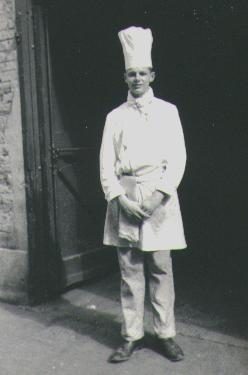
"My grandfather had his estate in the Slieve Bloom Mountains in central Ireland," Al wrote. "My grandmother was from London, and lived there except for a few weeks in the summer. She had bad rheumatism which was badly affected by the Irish damp climate … except for the summer months" [1]. So the household the boy was taken into in the late 1950s was two households: the major's, in the mountains, and Granny's, in London, with the summer weeks the one time all three were under a roof together. Two photographs survive of that roof, or its garden: "Granny Mitchell and Lawn, August 1957" — a woman in a rockery garden with a dog — and "Grandpa Mitchell and Lawn, Ireland, 1961," the same garden, the same kind of dog, four years on [5]. A third, "Al Krewson, Dublin, age 17," puts the boy in the city in 1960, where he "finished school" [5].
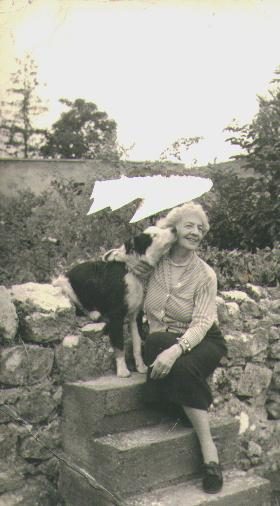
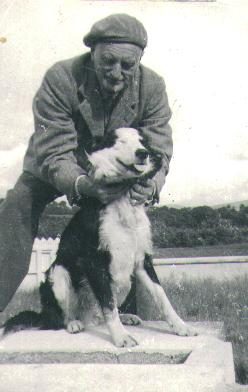
Glenn, who visited in 1963, gave the property a different address. "He had EXTENSIVE property holdings in Ireland, he is buried at the foot of the ruins of the castle Kiltubrid, property that went way back in family ownership/history" [3]. The family's record has spent some effort on that sentence and reached no bottom. The Slieve Blooms straddle the Laois–Offaly border; the one ruined castle Michael has been pointed to on a map, Tubbrid Castle at Barna in County Kilkenny, is a fifteenth-century tower house forty kilometres to the south-east, a roofless ruin from about 1900 until a private restoration in 2016–19, with no Mitchell in its recorded ownership; and Kiltubrid, spelled as Glenn spelled it, is a parish in County Leitrim, a hundred and fifty kilometres to the north, whose only castle ruin is Castle John on Lough Scur [6]. The book cannot say where the house was. It can say what would settle it: Herbert died without a will, so the Irish Calendar of Wills and Administrations for 1963 or 1964 should carry a grant of administration in his name, with his last address and the value of what he left — and that the entry exists in the National Archives of Ireland's catalogue and would not open when Michael tried it [6]. A letter to the Archives is the next step. Until it is answered, "an estate in the Slieve Bloom Mountains" is Al's phrase and the book uses it.
Two things the family says about Herbert Mitchell rest on no document at all: that he was in any sense a governor in Kenya, and that the Military Cross in the case was won in the Boer War. Both are kept here as the family told them, with the reasons for doubt beside them.
Al Krewson, 2002; Glenn Krewson, 2000; the family record's notes of 3 August 2026 [1] [3] [4].Why Al
Granny had told him, when he was old enough to ask why his brother and sisters had not come too, that "this wasn't possible, but she could have one of the grandchildren. She told me she chose me because I got the worst end of the deals back in 1946 and 1948, and she was trying to make this up to me" [7]. That is the whole of Al's account of why he crossed the Atlantic at fourteen or so, and he seems to have accepted it. He had, by the time he left, seen his father once more and exchanged letters with him, and he took those letters to Ireland and left them in Grandpa's keeping — the last chapter told what became of them [7].
Glenn's account of the same departure is the hardest passage in the family's archive, and the book has to decide what to do with it. His 2000 letter says that Al "lived with him for a while, since he had a personality disorder, and was in a mental institution" — Camarillo, the California state hospital — and that "Grandpa and Granny tried desperately to help him"; that "they were both so very much relieved to know I was not like my brother"; and that others had told him "Al also seems to have inherited this angry, mean spirited disposition" from their father [3]. Al's own letters, written five years later to the same nephew, mention none of this. They say polio, and the worst end of the deals, and Granny's guilt.
The book does not adjudicate between two brothers, both alive when they wrote, each describing the other to his nephew. It records that the two accounts exist, that they were written to the same person within five years of each other, that neither brother appears to have read the other's, and that on the one thing they both witnessed — the major, his medals, his silence, his dog on the lawn — they agree. The family's genealogist, asked in 2005 why the Krewsons never built up what other families did, answered that the rifts went back to the 1600s and that "no one was talking about what they were" [7]. He was one half of the rift he was describing, and this is as close as the archive comes to saying what it was.
The piano
One thing in this chapter is not from a letter. In 1987 or so, in California, Michael — sixteen — sat at a piano with his Uncle Al, who was trying to teach him Vangelis's theme from Chariots of Fire: the slow, repeated figure in the left hand, the melody that comes in over it [9]. It did not take, he says. But it is the one place in this family's whole archive where the boy from the train and the boy who would write this book were in the same room, and what Al was doing in it was the thing he had been made for in Ireland.
What the family says: that Al was a master pianist, "extremely talented"; that he played for seven years with the London Symphony Orchestra; and that, as a boy, he was made to practise locked in a room for eight hours a day "in some castle somewhere."
Michael's recollection of what he was told, 12 September 2026 [9].None of that is documented, and the book marks it so. The London Symphony Orchestra has no salaried pianist — a pianist appears with it as a guest or on a particular piece — so "seven years with the LSO" is not a thing that can be checked from the outside, and may be a family's compression of something true and smaller: a young man in London in the early 1960s, playing, and playing well. The locked room "in some castle" is Glenn's ruined castle and Al's house in the mountains heard through a child, and if it is true it is the other side of what Granny meant by making it up to him. A woman who took a Cambridge honours degree for granted and had married a major with an estate would have seen to it that the grandchild she chose was educated the way she understood education, and eight hours at a piano is what that looked like. Whether it was a gift or a sentence, the boy came out of it able to play, and thirty years later was still trying to pass it on. The archive has no recording. The book has this paragraph.
1963: the visit Al missed
In 1963 Glenn — twenty, a sailor in the United States Navy — went to see Granny in London and then on to Ireland to meet Grandpa. The two of them, by his own account, "got along so well, I really grew to love him, and he got to really love me" [3]; it was on that visit, he believed, that the major settled on him as the heir to the Irish property. Al was to have met his brother at Granny's in London, and could not. He was a soldier in the American garrison in West Berlin, twenty-two months after the Wall went up:
I was stationed in the Army in Berlin during the crisis, and we were too busy having to deal with possible riot controls due to people trying to escape from East Berlin and being shot by the Russians. Yes, this really happened. Leaves were scarce for outside of Berlin. I tried to get one but was refused, even though I wanted so much to see my brother after so many years … Don't forget that we were 110 miles behind the Iron Curtain, and the Russians were not open to letting people (especially American Army folks) pass through their checkpoints to the free world.
Al Krewson to Michael, 26 June 2002 [1].When he did reach London, almost a year later, Granny "was very upset with me that I did not come see her and your Dad, and let me have it without minced words. She felt that because your Dad could make it from the Navy all the way there from America, I could make the few hundred miles from Berlin. The difference was that your Dad didn't have a Wall or Iron Curtain in his way" [1]. Two brothers who had knelt together at the back window of a train in 1946 were, in 1963, a sailor in the Pacific Fleet and a soldier behind the Wall, and a grandmother in London was angry that they had not managed to be in the same room. They would not manage it, so far as the letters show, until Al came home. The Wall, the ship, and what the major's death did to the estate are the next chapter.
What the blood was
Al said the blood line was not Irish, but for a long time nobody in the family could have said what it actually was. Granny's own parents were two empty cards on the record: Félice Knight, born in Belgium, French before English, fluent in Spanish, and a story about Ferdinand and Isabella. Then a relative on her side of the family sent Michael three photographs of a typed letter — New York, 24 October 1919, "My dear Felicie" — from her cousin Gilbert Ward, who had "recently called specially on my aunt Julia, who only lately arrived in N. York from Costa Rica," and with her help had set down, for the first time in his life, "the loose strings" [10]. It is the whole of what the family now knows about where Granny came from, and none of it is Belgian.
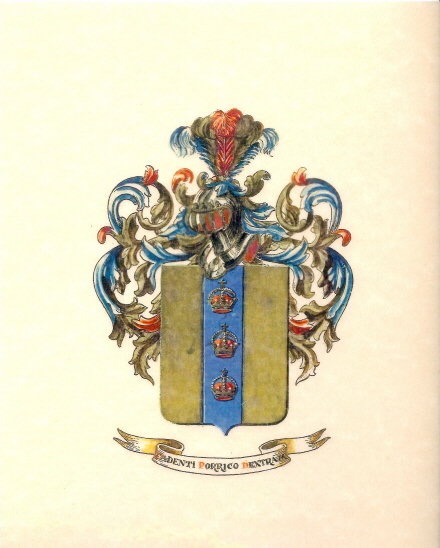
We will start with your grandfather William Knight, of english birth, a man of good family and finished accomplishments. Through him comes the coat of arms used by your uncle, Charles A. Knight and your father. He was a notable civil engineer and medical doctor. His mother, whose maiden name was Martel, died in Nuevitas, Cuba, of yellow fever … Mr. William Knight, your grandfather, prospered in his enterprises in Cuba, and among his properties there was in the district of Camagüey, a plantation in which there was a copper mine and it was called Las Minas. It was at this place, that your father, Henry F. Knight, was born.
Gilbert Ward to Félice Knight Marshall, New York, 24 October 1919, p. 1 [10].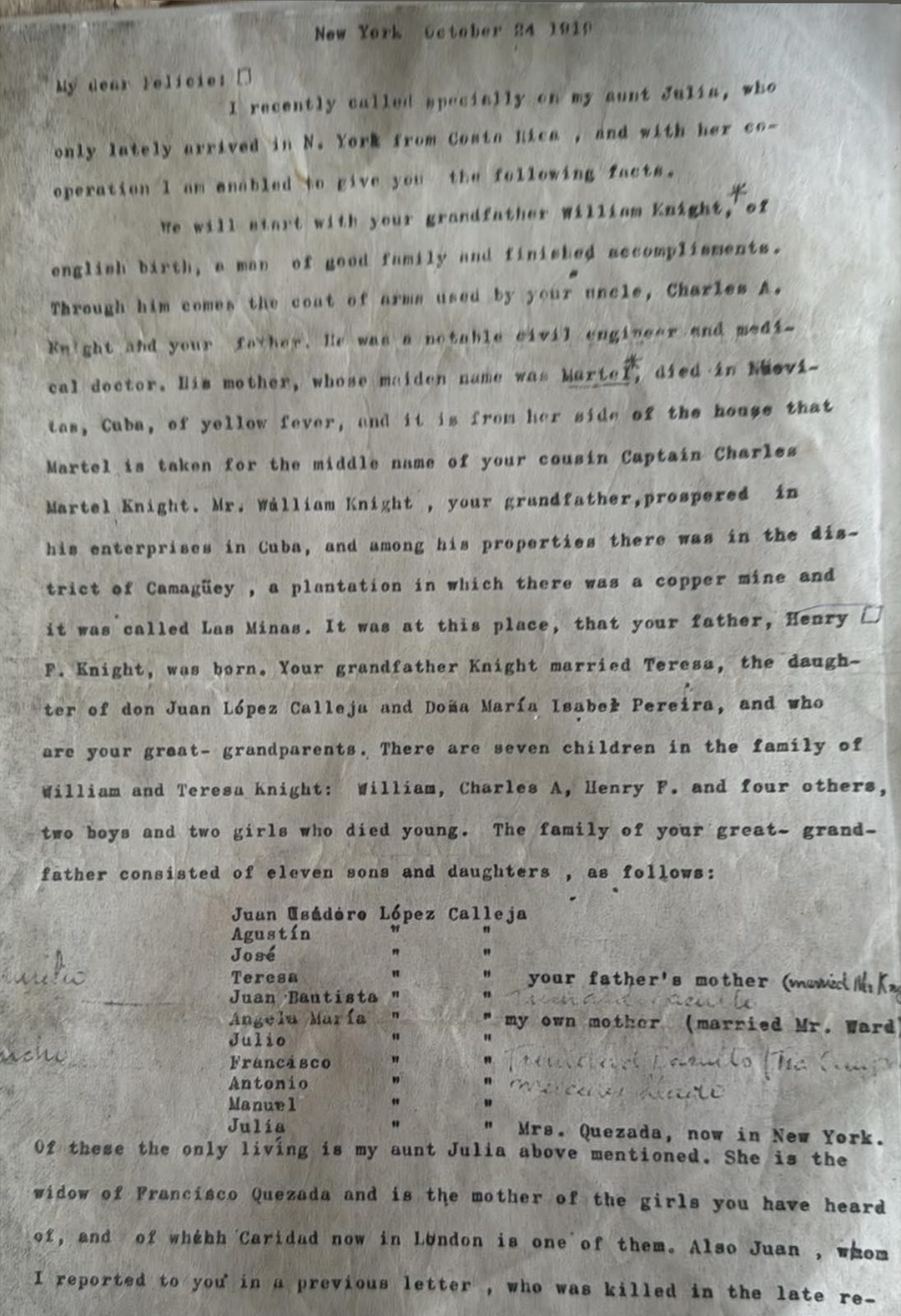
The arms are not only a phrase in an old letter. On 13 September 2026 Glenn texted Michael that Al's daughter Khrissie had found a relative on Granny's side who "recognized our family crest," and that the connection had "expanded" to "wealthy families with huge plantation ownings in Cuba and the Caribbean" [15]. The timing and the description both point to the same Knight-side relative who had sent Gilbert's letter two days before — a second branch of the family independently arriving at the same contact. A copy of the painted arms reached the record the same day.
Her father was Cuban-born and Spanish-speaking — "educated in the Spanish language, his native tongue" — which is where Granny's Spanish came from. Her grandmother was Teresa López Calleja, one of eleven children of an Asturian named Juan López Calleja Menéndez San Pedro, "the last two names … a mark of honor granted to families which had distinguished themselves in the wars with the Moors," who "owned several plantations, a great number of slaves, thousands of heads of cattle and horses" at Puerto Príncipe, the city that is now Camagüey. The records of his ancestry "were kept in an iron box at their City home," were sent to Spain to settle some legal matter, "and have been lost." There is the seed of Ferdinand and Isabella: a house entitled to honorific surnames from the Reconquista, which those two sovereigns completed in 1492, becomes in three generations of retelling a descent from the sovereigns themselves. The book leaves the legend labelled as it was, and adds that it now has a documented Spanish house behind it.
Then the war. The Ten Years' War, Cuba's first war of independence, ran from 1868 to 1878, and the letter's account of it is the account of every planter family that chose the wrong side: "practically all the family were exiled and the great portion of their fortunes lost to them." Several of the López Calleja sons "were drawn into the revolution and due to this, properties were confiscated, the slaves were emancipated and personal properties scattered and lost." One of them, Manuel, "a Colonel in the revolutionary forces, lost his life. He was young, very handsome and a man of rare refinement and education." The Knight boys came to the United States and lived in the Ward family's home in Delaware, where the eldest, William, died of a war wound and was buried at Milford. Henry, Granny's father, "finished his education in the U.S. and before going to Europe, was employed in a banking house in New York" [10] — which is the only line in three pages that reaches toward a daughter born in Belgium, and it does not reach far. Her mother is not named. That card is still empty.
The book has said, of Fortune in 1729 and of Jude, Striffin and Lydia in 1783, that a family's wealth was built by people it owned, and it says it here in the letter's own words. "A great number of slaves." The Cuban estates were worked by enslaved people until the war that ended both the estates and the slavery; no name from them has reached the record, and the letter, written by a grandson of the house in 1919, does not think to give one.
On the third page Gilbert goes one turn further back, and the family arrives somewhere it did not know it had been. Teresa's mother, María Isabel Pereira, was the daughter of Antonio Pereira and María Rita Falcón, and María Rita's father "was from Malta and came to Havana as a young man and married the Cuban girl."
His father, Falcón Sr., came to Havana from Malta in quest of his son, in his own yacht, but on finding that he had married, he returned to Malta without seeing him and very angry. This old gentleman was your great, great, great, great grandfather. So you will see, my cousin, from this rambling sketch, that you have reason to indulge in a bit of pride in your ancestors. But what is the use of ancestors in these days of the proletariat and bolsheviki? As a matter of fact, I owe to them only my character and my vices. I have never enjoyed any material benefits from their wealth, attainments or influence; in fact, this is the first time in my whole life that I have attempted to gather the loose strings.
Gilbert Ward to Félice, 24 October 1919, p. 3 [10].Four greats from Félice is seven from Michael. The old gentleman with the yacht is the earliest name on that side of the family, and he has no first name. One small thing, marked as small: Michael's own DNA ethnicity panel, run long before the letter arrived, has always carried a line nothing on the tree explained — Malta, under two per cent. A seventh- or eighth-great-grandfather is about the size of a trace. It does not prove the yacht [11].
The tree filled in the rest of her outline [12]. She was born in Brussels in 1889 — "abt 1890, Bruoselo," says a second copy of her on the tree, from the 1901 census of England, where she is an eleven-year-old boarder at Bramley, Surrey: a boarding school, which is where a Belgian child got her English. Her father, Henry Faustin Knight — the middle name is new — died in Paris on 15 September 1891, when she was two, and that is why in 1919 a cousin had to tell her who her people were: there had been no father to ask. She married Alfred at Windsor in April 1915; married the major at Newton Abbot in 1926; sailed into London from the River Plate on 18 February 1932, a South American voyage nobody remembered; and died on 28 December 1975 at Tangier, Morocco — across the strait from the Málaga Al had her retiring to. Her mother is still not named anywhere.
The iron box
Gilbert had written that the records of Juan López Calleja's ancestry, kept 'in an iron box at their City home,' had been 'sent to Spain for confirmation of some legal matters, and have been lost.' Michael asked what was behind the legend, and the book went to look. The Spanish state archives have a portal, PARES, and a search for the two words López Calleja returned twenty-five records. Two of them are this family, and one of them is fourteen pages long and digitised [13].
It is a file of the Havana government's Office of Embargoed Property from December 1872 — the middle of the war — opened 'para averiguar si Dn Juan López Callejas es el infidente Dn Juan López': to find out whether this man was the rebel of the same name on the government's list. A clerk had refused to process a sale. The seller's son, José López Calleja y Pereira, forty, 'natural de Matanzas … vecino y hacendado de Puerto-Príncipe,' wrote a petition on stamped paper on 11 December to say that the clerk had confused him and his father with two other Lópezes, and in doing so wrote his father's name in full [13]:
… el escribiente de aquel despacho ha confundido el apellido del exponente y el de su anciano padre dn Juan López-Calleja Menéndez y Sn Pedro natural de la provincia de Asturias y de 72 años de edad, hacendado en Puerto Príncipe con un dn José López de Nuevitas y un dn Juan López de la Habana ambos infidentes.
José López Calleja y Pereira to the Gobernador Superior Civil, Havana, 11 December 1872 — Archivo Histórico Nacional, ULTRAMAR, 4407, Exp. 89, p. 12 [13].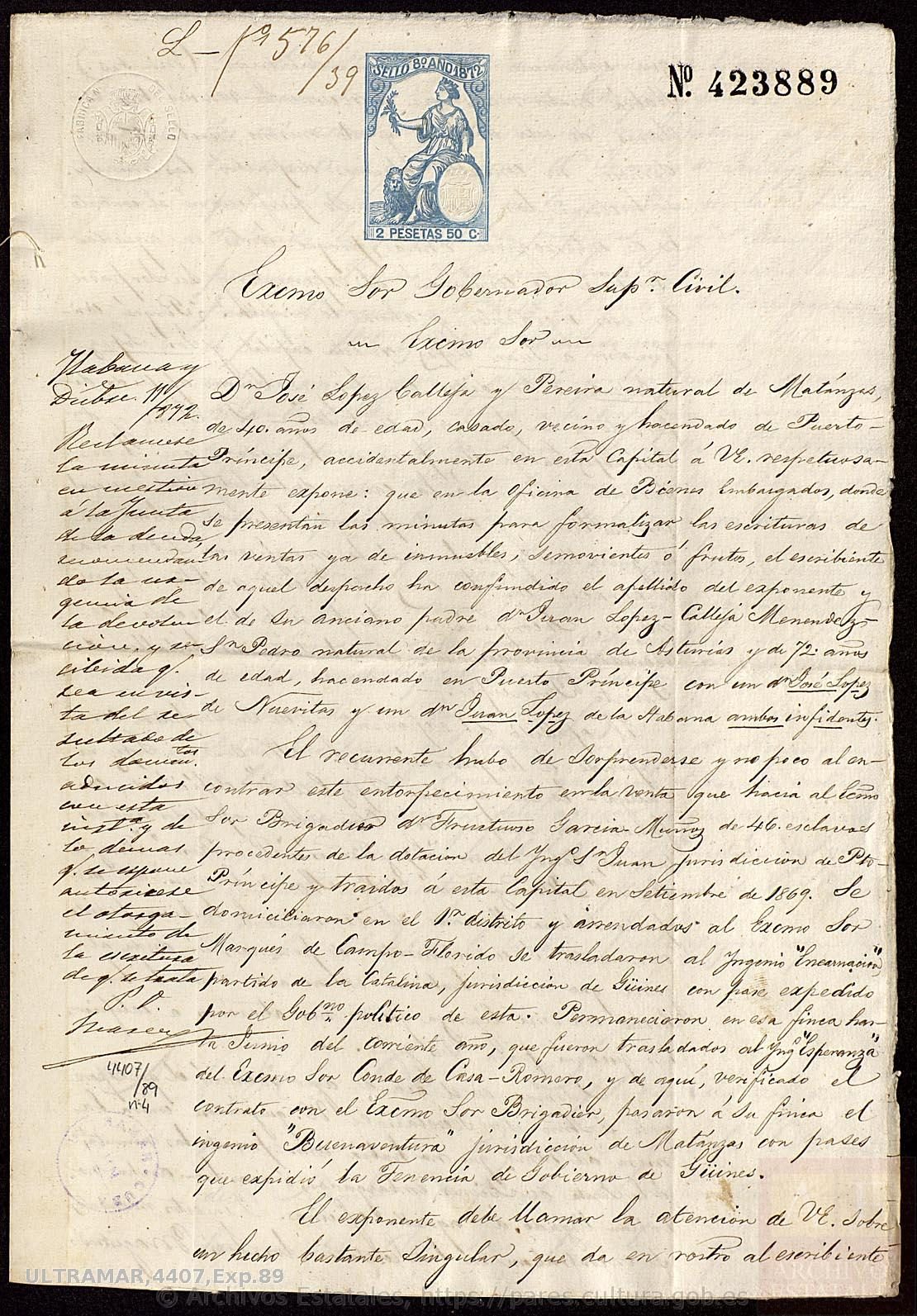
Juan López-Calleja Menéndez y San Pedro, native of the province of Asturias, seventy-two years old. The four names and the province, exactly as a grandson in New York would write them forty-seven years later, having never seen this file. The letter checks. The covering note has the old man 'residente en Costa Rica' — the exile; it is where his daughter Julia was still living in 1919. The petition names the estates the family had lost: two sugar mills, San Juan and Esperanza, and four cattle ranches in the partidos of Maraguán and Santa Cruz del Sur, 'víctimas que la insurrección con la tea había destruido' — burned by the rebels with the torch. And it gives the phrase 'a great number of slaves' a number. The dotación of Ingenio San Juan — forty-six enslaved people — had been marched to Havana under Spanish escort in September 1869, hired out to two titled planters, and were now being sold, twelve of them for twelve thousand dollars, to a brigadier of the Spanish army for his mill in Matanzas [13]. Three women had been sold four months before. The Governor approved the sale on 17 December.
Then the file says the thing the letter did not. José enclosed his papers as a volunteer of the Puerto Príncipe battalion and pleaded that he and his father 'son personas honradas, que han servido y sirven a la causa de la Integridad Nacional con sus bienes y con su persona; habiendo militado en las guerrillas y por lo cual la munificencia Soberana le agració con la cruz del Mérito militar' — loyal to Spain, decorated by Spain, burned out by the rebels [13]. Gilbert, in 1919, had the family 'drawn into the revolution,' its properties confiscated, its slaves emancipated, and a son, Manuel, dead as a colonel in the insurgent army. A petition to a colonial governor with forty-six people and forty-six thousand dollars at stake is not a neutral document; neither is a family letter half a century on. The likeliest reading is that both are true — a son a colonel for Cuba, a son a decorated volunteer for Spain, the father in Costa Rica — which would make the López Callejas the second family in this book to have stood on both sides of a war of independence, after the Kroesens and Crusers of 1776. Al's sentence about rifts turns out to reach across the Atlantic.
The second record is one folio in the Real Chancillería de Valladolid, the court that ruled on nobility for the north of Spain: a pleito de hidalguía — a suit to prove noble status — brought in 1776 by 'Juan Antonio, Manuel e Isidoro López Calleja, hermanos, vecinos de Laredo' [13]. Laredo is in Cantabria, sixty miles east of the Asturian border, and the folio is not online; but three brothers named Juan, Manuel and Isidoro proving their nobility in 1776, a generation before a Juan López Calleja was born who would name his sons Juan Isidoro, Juan Bautista and Manuel, is the right shape, and it is what an iron box 'sent to Spain for confirmation of some legal matters' would have held. The book calls it a lead and stops there. A suit of that kind rests on ancestors who were hidalgos de solar conocido — of a known ancestral house — and the two extra names, 'Menéndez San Pedro,' which Gilbert said were 'a mark of honor granted to families which had distinguished themselves in the wars with the Moors,' are how such a house was pointed at. That is the seed of Ferdinand and Isabella: not a crown, but a house whose claim to nobility was the Reconquista those two sovereigns finished. The legend stays labelled a legend. It has a documented house behind it now.
And the Englishman is in the same archive. 'Guillermo Knight, Ingeniero Civil' drew the 'Plano y perfil de la nueva Línea de Ferro Carril proyectado de la Bahía de la Habana a Matanzas' in March 1849; the Condes de Fernandina and Peñalver named him engineer of the Regla–Matanzas line; he proposed the Ferrocarril Central de Cuba himself in 1862, and was refused, the same year, permission 'para abrir en La Habana un banco con dinero inglés' [14]. 'A notable civil engineer,' the letter said. He was, and the years of the railway and the bank are the years his sons were born.
So the blood line was English, and Cuban, and Asturian, and Maltese, and the man who wrote that down did it in a year when ancestors were out of fashion and said so. Al was right that it was not Irish. He would have liked knowing what it was.
The ground it happened on
Period-general, as in every chapter: the country, not the household. The Slieve Bloom Mountains are the oldest in Ireland — a low, rounded range of Old Red Sandstone over Silurian slate, rising to a little over five hundred metres, capped with blanket bog and heather, cut by glens where the Barrow and the Nore have their sources [8]. In the 1950s their lower slopes were sheep grazing and small mixed farms; the bogs were cut for turf, by hand and, from that decade, by Bord na Móna's machines; the state forestry service was beginning the conifer plantations that now cover much of the range. A "big house" in such country was typically a Georgian or Victorian farmhouse or a former landlord's residence with a walled garden and a few hundred acres of grazing and bog, kept by one or two people and a dog — which is what the two lawn photographs show. Dublin in 1960, where Al finished school, was a city of six hundred thousand at the bottom of the emigration decade, the year after Seán Lemass's programme began to open the economy; a boy from Los Angeles in a Dublin secondary school would have been a curiosity, and would have learned Irish [8]. London in the same years, where Granny lived except for those few summer weeks, was still rebuilding from the Blitz; the "Roof Gardens" of the 1961 photograph are almost certainly the Derry & Toms roof garden in Kensington, opened in 1938 and one of the sights an Englishwoman would show a visiting grandson [5].
- Al Krewson to Michael, two emails of 26 June 2002 — family-history-uncle-al-2002-06-26.htm ("Our blood line is not Irish …", the 1963 visit, Berlin) and great-grandpa-and-grandpas-history-uncle-al-2002-06-26.htm (the major, the medal case, Kenya, Granny's Belgian birth and languages, her move to Málaga after "Grandpa died in 1963 or early 64"). The family record's story "Not Irish By Blood."
- Félice Marshall, "formerly Knight," and Alfred George Marshall, research chemist: GRO birth certificate of Margery Knight Marshall, 21 April 1922, 62 Foxley Lane, Purley (Application No. 4934606-1). The divorce and remarriage: Al's letters; no decree or marriage record on file.
- Glenn M. Krewson to Michael, 22 August 2000 — herbert-manifold-mitchell-glenn-krewson-2000-08-22.htm: the Kenya "military Lieutenant governor," the "EXTENSIVE property holdings," "buried at the foot of the ruins of the castle Kiltubrid," the intestacy and the USS Robison, the shrapnel death, the Military Cross and the refused Victoria Cross, and the passage on Al and Camarillo. Quoted as written. The family record's story "Major Herbert Manifold Mitchell, M.C."
- The Military Cross was instituted by Royal Warrant of 28 December 1914 (first awards gazetted 1 January 1915); it was not available for the Second Boer War (1899–1902). The family record's medal note of 3 August 2026 says the same and lists the nearer Boer-era decorations (a Distinguished Conduct Medal, a Mention in Despatches). No London Gazette citation for Herbert Manifold Mitchell has been found in a general search; a systematic Gazette search is an open task.
- Photographs in the family archive: "Granny Mitchell and Lawn, August 1957"; "Grandpa Mitchell and Lawn, Ireland, 1961"; "Al Krewson, Dublin, age 17" (c. 1960); "Granny Mitchell at Roof Gardens, London 1961"; "Granny Mitchell in London, 1962." The Derry & Toms identification is the book's inference from the name and the ivy-covered terrace, not a caption.
- The family record's location note on Herbert's card (3 August 2026): Tubbrid Castle, Barna, Co. Kilkenny (52°42′44″N 7°29′34″W; 15th-century tower house, roofless c. 1900–2016, restored by the Campion family 2016–19, National Monument; no Mitchell in its documented ownership) versus Kiltubrid parish, Co. Leitrim (Castle John, Lough Scur); the University of Galway Landed Estates Database (no Mitchell at either); the National Archives of Ireland's Calendar of Wills and Administrations 1923–1982 (the 1963 entry listed but not opening when tried; the Archives' documented 2024 outage of the same PDFs; query@nationalarchives.ie as the fix). A 1:08 video of Glenn narrating the castle exists in the archive and has not been transcribed.
- Al Krewson to Michael, 21 January 2005 (the second email): "she chose me because I got the worst end of the deals back in 1946 and 1948"; the letters left in Grandpa's care; "Seems like the whole Krewson line all the way back to the 1600s had these problems with rifts …" (20 January 2005). See chapter 13.
- The Slieve Bloom Mountains (geology, bog, forestry, the Barrow and Nore sources), Bord na Móna's mechanised turf-cutting from the 1950s, Dublin's population and the 1958 Programme for Economic Expansion, and the Derry & Toms roof garden: general histories and reference works; stated as period-general, not as a record of this household.
- Michael's own memory, told to Claude 12 September 2026: Al trying to teach him Vangelis's "Chariots of Fire" (1981) on the piano, c. 1987; and what he was told of Al's playing — the London Symphony Orchestra, "seven years," the locked room, "master pianist, extremely talented." First-hand for the lesson; family legend for the rest, and marked so. The LSO's constitution (a self-governing orchestra of string, wind, brass and percussion members, with pianists engaged per concert) is why the seven years cannot be verified against a roster.
- Gilbert Ward to Félice Knight Marshall, New York, 24 October 1919, three typed pages with pencil annotations, photographed and sent to Michael over Facebook Messenger on 11 September 2026 by a relative on the Knight side, with an Ancestry-style tree of the Knight/Marshall/Krewson line drawn in Spanish — archived as gilbert-ward-letter-to-felicie-knight-1919-10-24-page{1,2,3} and knight-lopez-calleja-krewson-family-tree-2026-09-11.png. Quoted as typed, including "english" and "bolsheviki." The letter lists the eleven López Calleja children by name (Juan Isidoro, Agustín, José, Teresa, Juan Bautista, Angela María, Julio, Francisco, Antonio, Manuel, Julia) and gives the sender's own descent through Angela María and a Mr. Ward of Delaware. The Ten Years' War dates (10 October 1868 – February 1878) are the standard ones. The family record's story "The Letter to Felicie, 1919" and its nineteen new cards.
- FamilyTreeDNA myOrigins v3 for Michael Krewson: England, Wales and Scotland 88%, Scandinavia 8%, Malta <2%, West Slavic <2%, Greece & Balkans, Baltic and Ashkenazi Jewish each <1% (the family record's DNA & Ethnicity panel, uploaded 2026-08-03). A 6×-great-grandparent contributes on average 1/256 of autosomal DNA, about 0.4%; trace-level population calls are noisy and "Malta" as a reference population overlaps Sicily and southern Italy. Stated as consistent with the letter, not as evidence for it.
- Michael's own Ancestry.com tree, "Krewson Family Tree," exported as a GEDCOM 11 September 2026 (krewson-family-tree-ancestry-2026-09-11.ged, archived in the family record): "Hubert Manifold Mitchell," b. abt 1895 Parsonstown, d. 24 Nov 1962 Dublin, m. Felice Knight 1926 Newton Abbot — no record collection attached to any of the three, so recorded as the tree's own entries; Felice Knight, b. 1889 Brussels (Ancestry Family Trees; UK and Ireland Incoming Passenger Lists 1878–1960; 1901 England Census — boarder, Bramley, Surrey), m. April 1915 Windsor (England & Wales Civil Registration Marriage Index 1837–1915), arrival London 18 Feb 1932 from the River Plate, d. 28 Dec 1975 Tangier (unsourced on the tree); Henry Faustin Knight, b. abt 1856 "Las Minas (Ile de Cuba)," d. 15 Sept 1891 Paris (Paris, France, Births, Marriages and Deaths 1555–1929; Maine, U.S., Arriving and Departing Passenger and Crew Lists). The family record's story "The Tree Michael Built."
- Archivo Histórico Nacional (Madrid), Ministerio de Ultramar, ULTRAMAR, 4407, Exp. 89 (1872), "Expediente instruido para averiguar si el llamado José López Calleja y Pereira que solicita autorización para vender unos negros, y su padre Juan López Calleja Menéndez, del cual son propiedad dichos esclavos, son los infidentes Juan López, de La Habana, y José López, de Nuevitas, cuyos bienes están embargados" — 14 digitised pages (PARES description 6746803), read and archived in the family record 11 September 2026 (ahn-ultramar-4407-exp89-lopez-calleja-1872-p01…p14.jpg): the Governor's registry cover (p. 1); the Junta de la Deuda's report of 16 Dec 1872 (pp. 2–4); the authorisation of 17 Dec (p. 5); the Negociado de Embargos consulta of 5 Dec with the Brigadier García Muñoz sale of "12 esclavos … $12,000" (pp. 6–8); drafts (pp. 9–11); José López Calleja y Pereira's petition of 11 Dec 1872 on Sello 8º paper (pp. 12–14), quoted as written. Archivo de la Real Chancillería de Valladolid, Sala de Hijosdalgo, Caja 1151, 34 (1776), "Pleito de Juan Antonio, Manuel e Isidoro López Calleja, hermanos, vecinos de Laredo (Cantabria)," 1 folio, not digitised (PARES 472386). Reproduction of public-domain documents from the Archivos Estatales is permitted with attribution to the Ministerio de Cultura and the citation given. The family record's story "The Iron Box, Found."
- Archivo Histórico Nacional, Ministerio de Ultramar: ULTRAMAR, 135, Exp. 1 (1846–59), the Regla–Matanzas railway, "cuyo proyecto se encarga al ingeniero Guillermo Knight"; ULTRAMAR, MPD. 1647 (24 Mar 1849), "Plano y perfil de la nueva Linia de Ferro Carril proyectado de la Bahía de la Habana a Matanzas … Realizado por Guillermo Knight, Ingeniero Civil" (catalogued, not digitised); ULTRAMAR, 236, Exp. 4 (1862–64), the Ferrocarril Central proposals, Knight's rejected by Royal Order of 5 July 1862; ULTRAMAR, 67, Exp. 9 (1862–64), "D. Guillermo Knight solicita permiso para abrir en La Habana un banco con dinero inglés. Denegado." That "Guillermo Knight" the engineer is William Knight (b. c.1817, England) of the 1919 letter is the book's identification from the profession, the place and the decades; no document yet joins the two names.
- Glenn Krewson to Michael, text messages, 13 September 2026: Al's daughter Khrissie "came across a relative of my granny," who "seems to know a lot about granny's side of the family" and "recognized our family crest," the connection then expanding to "wealthy families with huge plantation ownings in Cuba and the Caribbean." Quoted as texted. The coat of arms itself, archived as knight-family-coat-of-arms.jpg, and in the family record on William Knight's and Glenn's cards.